
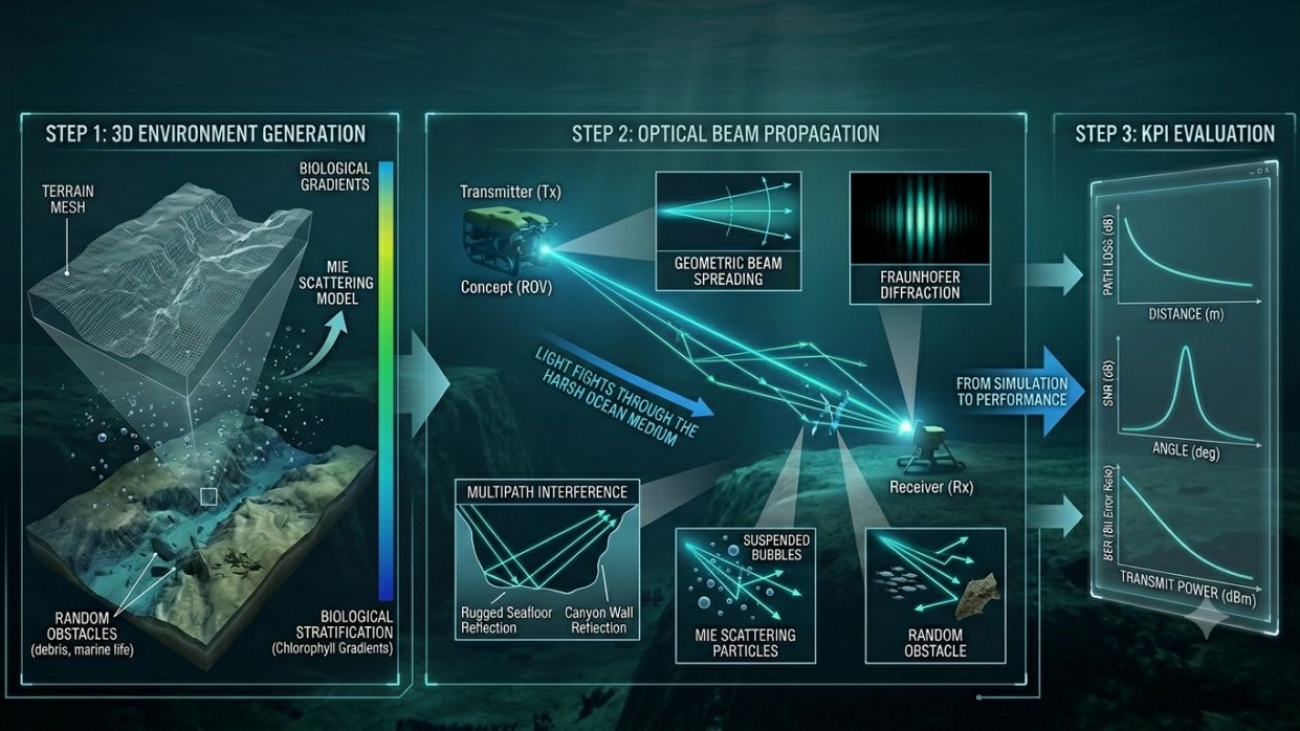
Underwater Optical Wireless Communication (UOWC) has emerged as a promising complement to traditional acoustic and radio-frequency (RF) underwater links, offering substantially higher data rates and lower latency over short-to-moderate ranges. However, the underwater optical channel is notoriously difficult to characterize: absorption, scattering, and turbulence interact in ways that vary strongly with water type, depth, and environmental conditions, making real-world deployment and testing costly and logistically constrained. InnoCube, as part of its work within the AVALON project, is developing high-fidelity simulation frameworks that reproduce realistic 3D underwater optical propagation scenarios, allowing researchers and engineers to evaluate UOWC system performance before committing to expensive field trials.
The Case for Simulation-Driven UOWC Development
Unlike terrestrial free-space optical links, underwater optical channels are governed by wavelength-dependent absorption coefficients, multiple scattering events caused by suspended particulates, and turbulence-induced scintillation driven by temperature and salinity gradients. These effects vary drastically between clear ocean water, coastal water, and turbid harbor environments, meaning that a system optimized for one water type can perform very differently in another. Building physical testbeds that replicate this full range of conditions is expensive and slow, which is why simulation tools that model the underwater channel with physical accuracy have become central to UOWC research and system design.
High-fidelity simulators typically combine radiative transfer modeling (accounting for absorption and scattering coefficients derived from Jerlov water-type classifications) with Monte Carlo photon-tracing methods to estimate channel impulse response, received optical power, and bit-error-rate (BER) performance under varying link geometries. Some open frameworks, such as Monte Carlo-based tools derived from earlier laser-propagation simulators, model the underwater channel by tracing photon paths through a scattering and absorbing medium to reconstruct the frequency response and total received power at the receiver. Extending these approaches into full 3D scene rendering—incorporating realistic geometry, water turbidity gradients, and non-line-of-sight (NLOS) propagation paths—provides a much richer testbed than simplified analytical channel models.
Architecture of a 3D Underwater Optical Simulation Framework
InnoCube’s simulation approach for UOWC centers on reconstructing realistic underwater scenes in three dimensions, rather than relying solely on statistical channel models. This involves several architectural layers:
- Physical channel modeling: absorption and scattering coefficients are parameterized by water type (clear, coastal, turbid) and combined with turbulence models to capture scintillation and beam spreading effects.
- Geometric scene reconstruction: 3D underwater environments, including seafloor topology, obstacles, and transceiver placement, are modeled to support both line-of-sight (LOS) and NLOS link evaluation, addressing a key limitation of purely analytical UOWC models.
- Photon-level propagation simulation: Monte Carlo ray/photon tracing is used to estimate how light interacts with the medium across the transmitter-receiver path, producing metrics such as channel impulse response and path loss.
- Performance evaluation layer: derived channel outputs feed into link-level performance estimation, including achievable data rate, BER, and maximum communication range under a given modulation scheme (e.g., on-off keying, pulse position modulation, or subcarrier intensity modulation).
This layered architecture mirrors approaches seen in adjacent research, where 3D scene simulation frameworks generate synthetic underwater imagery and propagation data to validate optical sensing and communication systems without requiring continuous field access.
Methodology and Tools
The simulation methodology draws on established techniques in the UOWC literature, particularly Monte Carlo channel modeling, which has been used to characterize how absorption and turbidity jointly shape the received signal in underwater optical links. Turbulence modeling techniques—originally developed to isolate scintillation effects from absorption and scattering—allow the simulation to separate the contribution of temperature-driven refractive index fluctuations from static water-quality effects, which is critical for realistic performance prediction across depth and thermal gradients. Machine learning (ML) components can additionally be layered onto the simulated channel outputs to improve adaptive threshold detection and forward error correction (FEC) performance under varying turbidity, an approach shown in recent UOWC studies to reduce bit-error rates by an order of magnitude across different water conditions.
By integrating 3D geometric modeling with these established channel-modeling techniques, the simulation framework produces synthetic datasets that closely approximate real oceanic conditions, including scenarios with obstructions, variable turbidity, and NLOS geometries that are difficult to instrument physically. This enables system-level evaluation of physical layer security mechanisms and AI/ML-driven signal processing techniques ahead of hardware deployment.
InnoCube’s Role Within AVALON
InnoCube leads critical components of the AVALON project, which is designing a UOWC network architecture intended to support high-speed underwater communication over distances up to 100 metres and beyond direct line-of-sight, with applications spanning sea border protection and deep-sea exploration. Within this effort, InnoCube’s contribution centers on AI/ML-driven innovations and physical layer security mechanisms for underwater optical links, supported by the simulation infrastructure needed to test these mechanisms under realistic channel conditions. As a boutique research and development company, InnoCube positions itself as the bridge between theoretical UOWC research and deployable system prototypes, delivering feasibility studies and high-complexity simulations that de-risk later stages of hardware development.
Impact and Next Steps
Realistic 3D underwater optical simulation reduces the dependency on costly field trials while improving confidence in system performance predictions across diverse water conditions, a persistent bottleneck for UOWC research and deployment. As AVALON progresses, this simulation capability is expected to support the validation of AI-enhanced signal processing and security mechanisms for next-generation underwater optical networks. Those interested in the technical details of the AVALON project or potential collaboration on underwater optical wireless systems are encouraged to explore the project page or contact InnoCube directly.
Further Reading
“AVALON: UnderwAter optical wireless communication network architecture empowered by adVanced opticAl materiaLs for sea bOrder protection and deep-sea exploratioN,” InnoCube Project Portfolio, 2024. (https://innocube.org/portfolio/avalon/)